
THE 100-YEAR REVOLUTION OF THE KITCHENAID MIXER
- 0
- 16-10-2026
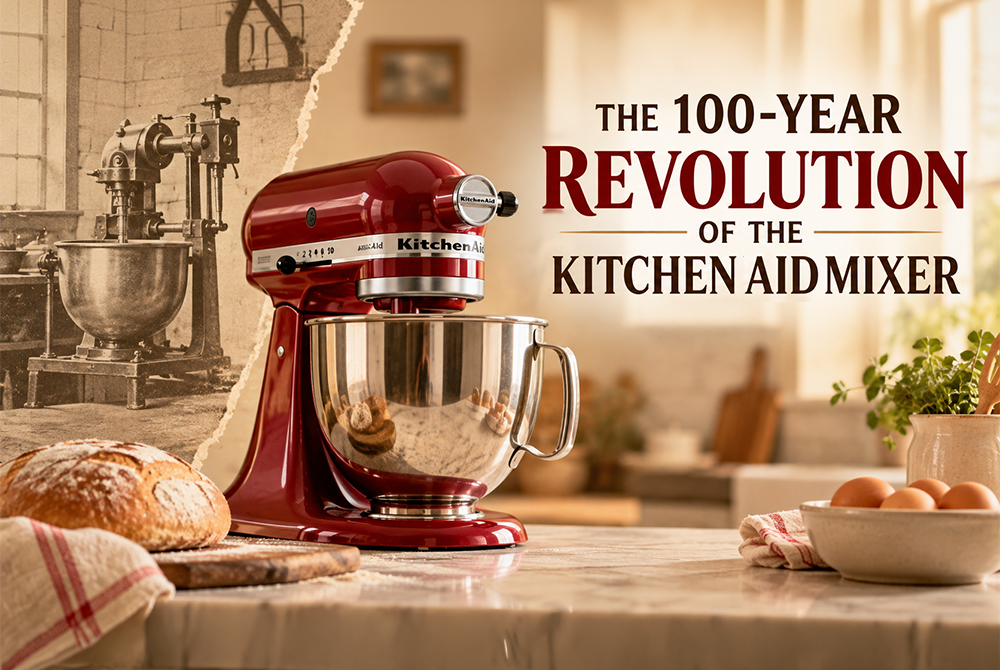
In 1914, engineer Herbert Johnson watched a baker sweat profusely as he struggled to mix heavy bread dough in a giant vat with a massive iron spoon. Johnson thought to himself: "A human arm should not be burdened with such heavy and monotonous mechanical work."
He built a special electric mixer. However, this first model was not meant for homes, but for the huge warships of the U.S. Navy—it could knead 80 liters of dough at once and was used to bake bread for thousands of sailors.
After the war, Johnson scaled the system down to fit home kitchens and distributed prototypes to the wives of executives at the Hobart company for testing. Fascinated by this appliance—which kneaded dough, whipped eggs, and frothed cream in seconds—one of the executive's wives exclaimed:
"I don't care what you call it, but it's the best kitchen aid I've ever had!"
Thus, for the first time in history, an official product name was coined not by its creators, but by a woman whose work it saved: KitchenAid.
Primitive mixers back then simply rotated the whisk in a single stationary spot, leaving the flour and sugar along the edges of the bowl unmixed. Inspired by astronomy, Johnson invented the "Planetary Action" mechanism: while the whisk rotated clockwise around its own axis, it simultaneously orbited the inside of the bowl in the opposite direction (just like the Earth moving around the Sun). This movement left no spot untouched, making the dough significantly more voluminous and elastic than if kneaded by hand.
In 1937, famous industrial designer Egmont Arens gave the mixer its smooth, streamlined, and tilt-head "Model K" design. Remarkably, the exterior look and mechanical core of the KitchenAid models we see in kitchens today are almost 100% identical to that 1937 design.
A heavy industrial machine created to knead bread for sailors on warships has transformed into the world's most aesthetic and durable kitchen legend today.