
Why was the first vacuum cleaner in history horse-drawn and kept outside the house?
- 0
- 16-07-2026
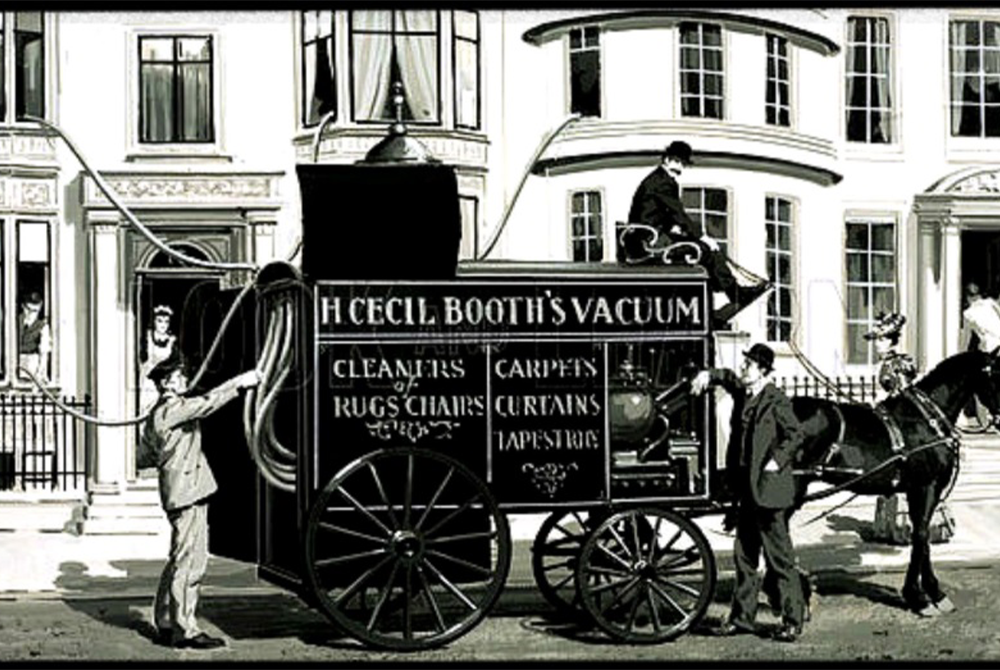
Today, when we think of house cleaning, we immediately imagine silent robot vacuum cleaners that use smart sensors to recognize rooms and automatically return to their charging stations once the work is finished. It takes just one touch of a button for the device to clean the entire house systematically. However, just a century ago, the situation was entirely different. Back then, the first motorized vacuum cleaners not only failed to fit inside a house, but horse-drawn carriages were even used to transport them from one place to another.
In 1901, the English engineer Hubert Cecil Booth developed a device called "Puffing Billy," which is considered one of the first practical motorized vacuum cleaners in the world. Booth got this idea after observing machines that cleaned by blowing dust into the air. He thought that collecting the dust through a powerful suction system, rather than blowing it away, would be more effective. This very idea laid the foundation for modern vacuum cleaner technology.
"Puffing Billy" was enormous compared to today's household appliances. Because this machine, powered by a gasoline engine, was very heavy, ordinary people could not move it. The device was placed on a special horse-drawn carriage and brought to the front of the house that had requested the service. The machine was so large that it was impossible to move it through a door. Therefore, the vacuum cleaner was kept in the street, and long, thick hoses were extended through windows into the rooms of the house. Through these hoses, which were about 30 meters long, dust and dirt were sucked from carpets, furniture, and floors and collected in a special dust compartment in the machine.
For that era, this process appeared quite unusual and interesting. However, the device also had serious drawbacks. The gasoline engine was very loud and created a great deal of noise on the street. Some sources even note that this roaring sound frightened passing horses and caused dissatisfaction among city residents. In some cases, police would warn or fine the operators for creating a disturbance. Furthermore, the smell of gasoline was noticeable during the operation of the device, which made it even more uncomfortable to use.
One of the interesting facts is that the vacuum cleaner service was not accessible to everyone at that time. Due to the high cost of the device, it was mainly ordered by wealthy families. The massive machine parked in front of the house would attract the attention of neighbors, and people watched this new technology with curiosity. Some wealthy families even invited their guests to watch the dust being sucked through transparent pipes over tea, presenting it as a kind of technology demonstration. In that era, owning or using this vacuum cleaner service was considered a sign of social status.
Today, thanks to artificial intelligence and sensor technology, robot vacuum cleaners can map the house, recognize obstacles, avoid falling down stairs, and be controlled remotely via mobile apps. They are many times quieter, more efficient, and more functional compared to earlier generations of devices. The massive machines that once operated with a roar on the street and were transported by horse carriages have turned into palm-sized smart devices today.
History shows that great technological innovations do not often start as simple and convenient products. If not for the "Puffing Billy," which seemed strange at first glance, perhaps the modern robot vacuum cleaners we use today would not exist. Therefore, the robot vacuum cleaner working quietly in our home is not only a result of modern technology but also the successful outcome of over a century of engineering progress and human creativity.